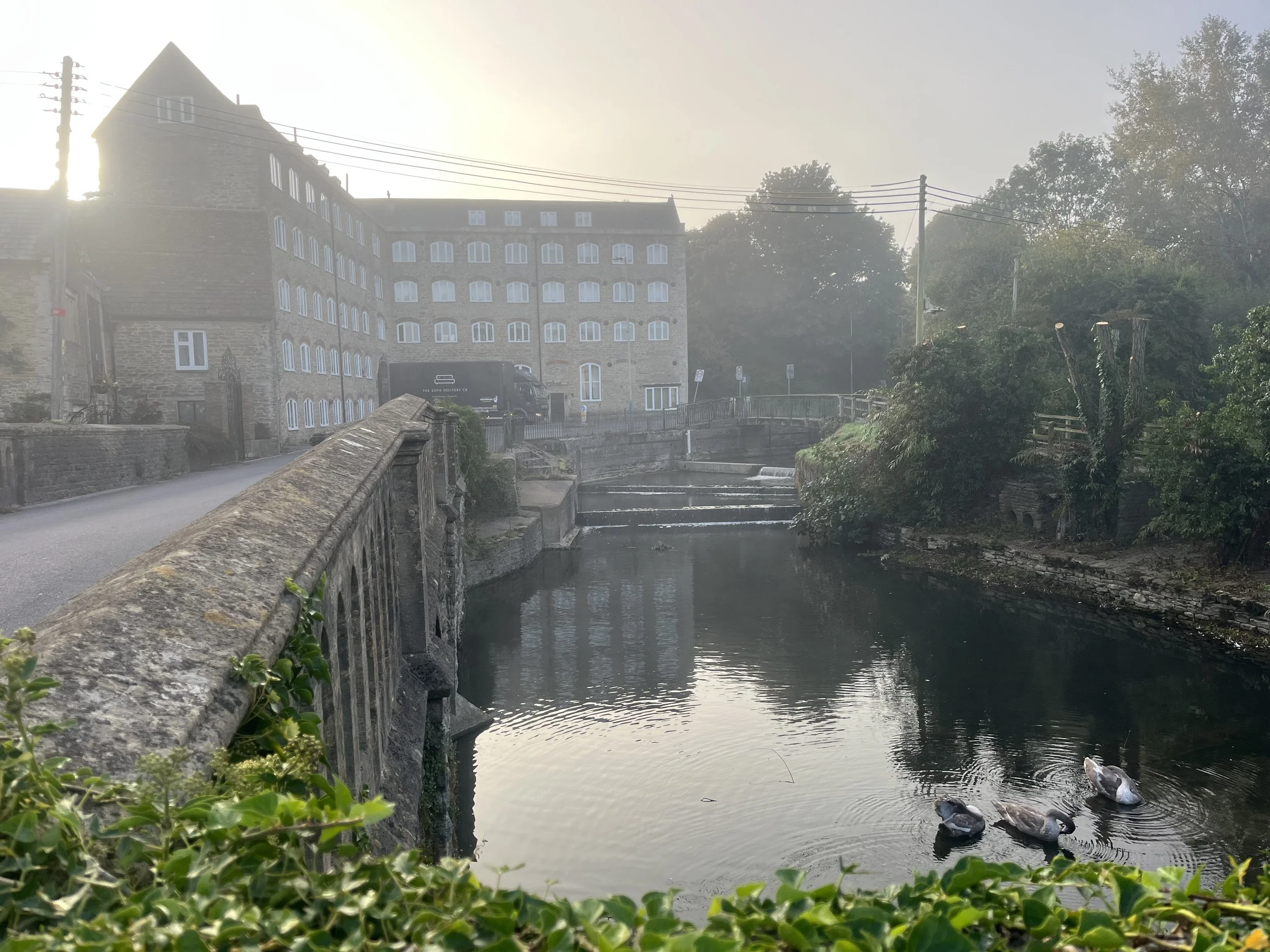
River Avon at the Malmesbury town bridge
Water has always been central to the life of Malmesbury. The rivers that surround the town on three sides have shaped its landscape, its history and its identity, providing the reason for settlement here since prehistoric times. Water has also played an important part in the town's industrial past, providing the energy to power mills and machinery.
It seemed fitting, therefore, that water should become the subject of a new sound work, Waterpower, commissioned for the Malmesbury River Festival in 2024.
The piece brings together recordings of the natural river environment around Malmesbury with an original musical composition. Field recordings capture the sounds of flowing water, wildlife and the surrounding habitat, creating a soundscape that explores both the beauty and the power of water, and our changing relationship with it.
I recorded the river at different times and in very different conditions, from periods of flood, when water becomes a powerful and sometimes destructive force, to times of drought, which have become increasingly extreme. Each recording reveals a different character. Sometimes the water is gentle and almost meditative; at other times it is restless, turbulent and unsettling.
The sound of industry
Alongside these natural sounds, I composed music using instruments chosen for their connection with the character and history of the place. The principal instrument is the cymbelum, an unusual and relatively rare stringed instrument played with hammers. Its distinctive, resonant and percussive sound seemed particularly appropriate for the piece, evoking something of the machinery and industry that Malmesbury's rivers once helped to power.
I had been asked to tune a cymbelum in Malmesbury and was fortunate to have the opportunity not only to work on the instrument but also to play and record it in situ. The instrument has a particular tradition of accomplished female performers, and I felt privileged to be given access to it.
There was something especially satisfying about recording this unusual instrument in Malmesbury itself, bringing together the sounds of the river with an instrument whose character seemed to echo the town's industrial heritage.
The photograph accompanying this article shows the silk mill in Malmesbury, a reminder of the importance of water power to the town's industrial history.
The changing character of water
The composition moves between moments of calm and passages of greater intensity. There are peaceful sections in which the natural sounds of the river and its wildlife come to the foreground, and more dramatic sequences where the music becomes darker and more disquieting.
I wanted to explore the contrasting qualities of water: its ability to sustain life, provide nourishment and create beauty, but also its potential to overwhelm, destroy and disrupt.
These contrasts seem increasingly relevant as changing weather patterns bring more extreme periods of flood and drought. The river is never entirely predictable, and the music reflects something of this uncertainty.
An immersive sound installation
During the summers of 2025 and 2026, Waterpower was presented as an outdoor sound installation in the courtyard at Caerbladon Gallery in Malmesbury.
The sixteen-minute composition was played through four speakers arranged to create an immersive surround-sound environment. A LiDAR sensor detected when visitors entered the courtyard and triggered the piece to begin. When the space was empty, the sound stopped after thirty seconds, ready to begin again from the start when the next visitor arrived.
I placed a bench in the courtyard so that visitors could sit and listen to the complete work, allowing themselves time to become immersed in the sounds and music.
At the centre of the space was a water sculpture, its presence reflecting and complementing the sounds of water within the composition. The combination of the sculpture, the surrounding speakers and the outdoor setting created an environment in which the recorded sounds of the river could be experienced in a different way.
Rather than simply listening to a piece of music, visitors were invited to enter a space, pause and become part of the experience.
Waterpower was subsequently presented as part of the Malmesbury Festival of Place in 2026, continuing its connection with the town and its cultural life.
Listening to the river
Malmesbury's rivers are easy to take for granted, yet they are fundamental to the place. They have influenced where people settled, how the town developed and the character of its landscape. They have provided energy for industry, habitats for wildlife and a constant presence in the life of the town.
Waterpower is an attempt to listen more closely to this environment, bringing together its natural sounds, its industrial history and the human impulse to harness its energy.
Water is both a life-giving presence and a force beyond our control. Through sound, I hope Waterpower offers a way of reconnecting with the rivers of Malmesbury and recognising just how much they continue to shape the place we call home.
